Docs / Guide
Whale trades
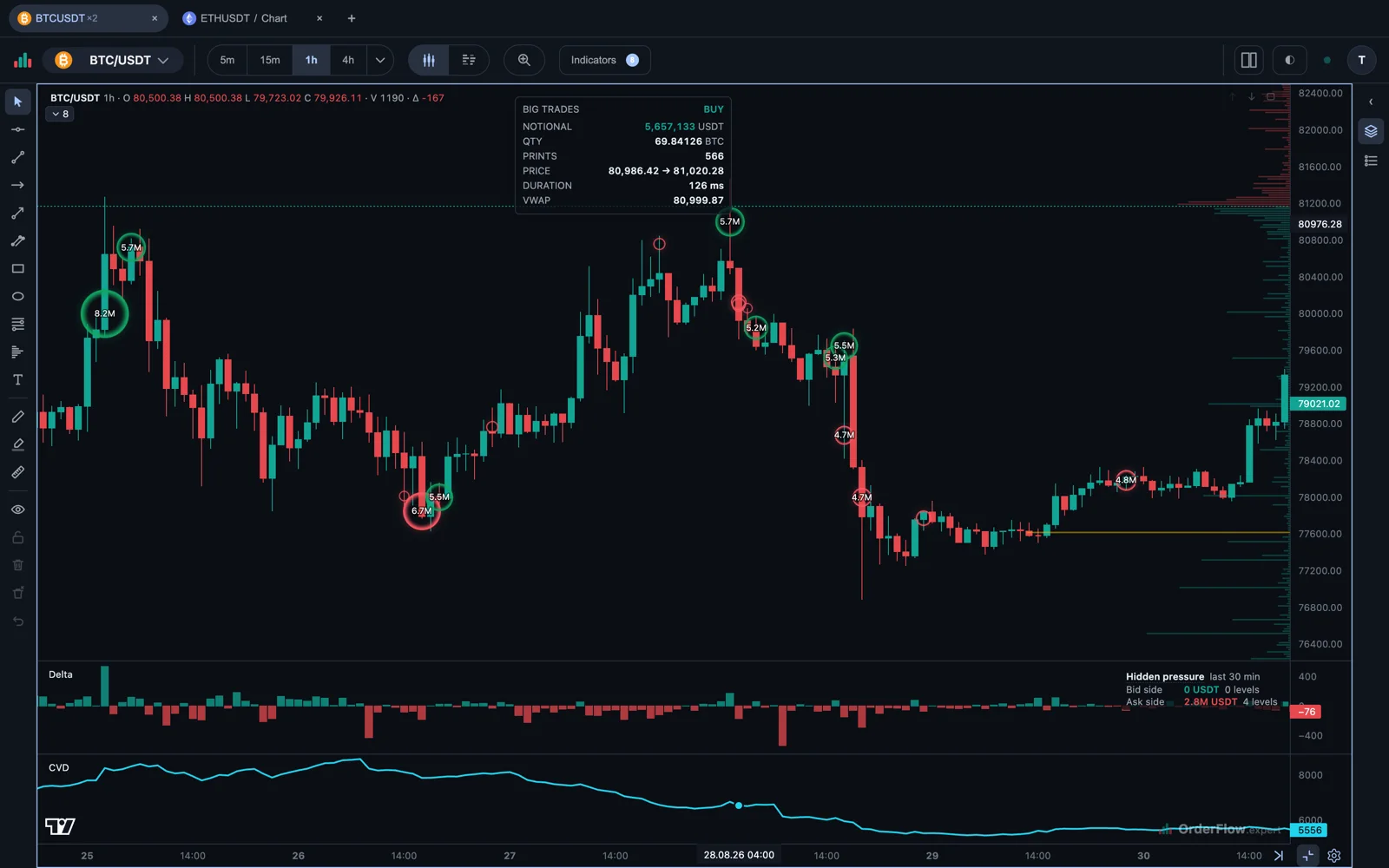
A whale trade is one large market order sent by a single participant. The exchange reports it as many small prints; the terminal glues them back into one aggression, so one bubble on the chart is one whale, not one print.
Updated
One whale, many prints
An exchange can report one market order as several prints while it eats through the limit orders at several price levels. Counting those prints separately makes one participant look like many small trades. A large order can therefore arrive as a sequence of fragments even though it was one decision to cross the spread.
What we count instead
Whale trades reconstruct that sequence into one aggression: consecutive, same-side prints that belong to the same taker move are grouped as one event. The bubble is a compact way to see where a participant pushed through liquidity, without mistaking every exchange fragment for a separate whale.
The threshold
The threshold is set per instrument and derived from its own turnover. A fixed dollar amount would mean very different things on a highly liquid symbol and a thin one. Tune the threshold until the bubbles highlight exceptional events for the market and timeframe you are studying, not every active bar.
Reading the bubbles
Bubble size represents the reconstructed event size and colour shows the side that sent the market order. A single bubble can mark urgency; several bubbles at one level can show repeated participation. Read them with the footprint and liquidity: did price continue, did a wall of limit orders absorb the flow, or did the order merely finish a move already under way? A bubble on its own is not a reason to trade. At a level that matters, and with price confirming it, it is evidence worth weighing. The Liquidity Heatmap shows what was waiting at that level before the order arrived.
Common questions
What counts as a whale trade? An aggression whose size passes the instrument’s threshold. The threshold comes from that instrument’s own turnover, so a whale on a thin market is smaller in dollars than a whale on BTC/USDT.
Is a buy bubble bullish? It says that one participant sent a large market buy at that moment, and nothing more. Price can fall straight after it — for example when the order runs into a wall of limit sellers that absorbs it. The level, the footprint and what price does next decide what the bubble means.
Can I be told when a whale trade happens? Yes. An alert on whale trades above a size you choose is checked on our servers, so it fires with your browser closed and reaches you in Telegram.